Kilimanjaro is a high-altitude expedition, not a fitness challenge with a guaranteed summit. Tanzania’s mountain offers a remarkable progression from forest to exposed upper slopes, but the most important booking decisions concern the ascent profile, the operator and the plan for turning back safely.
Use this guide to compare proposals and prepare questions. It does not replace personalised medical advice, your guide’s assessment or current park instructions.
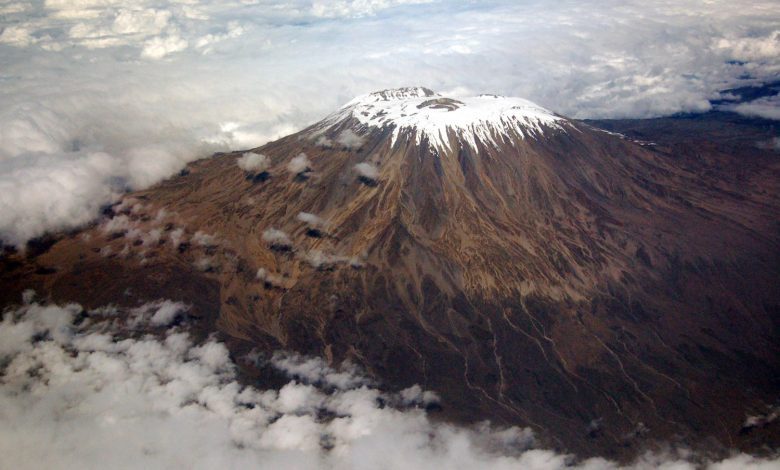
Featured photo: Paul Shaffner, archival aerial photograph (2007), CC BY 2.0, via Wikimedia Commons. This historical image is not a guide to current snow or glacier conditions.
At a glance: what to decide before paying
| Decision | What to compare |
|---|---|
| Route | Daily sleeping altitudes, terrain and accommodation—not an “easy” label |
| Trip length | Actual mountain days, acclimatisation opportunities and separate arrival/departure nights |
| Operator | Licensing, guide experience, emergency arrangements and staff welfare |
| Budget | Written inclusions, exclusions, equipment, fees and cancellation terms |
Choosing between Marangu, Machame, Lemosho and Rongai
Start with the park authority’s current visitor guidance and an itemised operator proposal. Marangu uses mountain huts; other commonly offered routes use designated camps. Hut accommodation does not make a rapid ascent medically easy.
For Machame, Lemosho or Rongai, ask for the precise itinerary rather than assuming all departures with the same route name are equivalent. Compare the number of nights, daily sleeping locations, ascent and descent plan, transfer arrangements and contingency decisions. No unsupported success-rate ranking is presented here.
A longer itinerary may provide more room for acclimatisation, but extra nights alone do not guarantee a safe or successful ascent. Discuss the actual altitude profile with a travel-health professional and your operator. Do not select the shortest product solely to save leave days.
Altitude: symptoms override the summit goal
Review the CDC Yellow Book’s altitude guidance before booking. Fitness does not protect against altitude illness. Gradual ascent is important; consult a clinician about your itinerary, health history and whether preventive medication is appropriate.
Tell your guide promptly about headache, nausea, unusual fatigue or other symptoms. Do not ascend to sleep higher while symptoms persist. Worsening symptoms at the same altitude require descent. Confusion, loss of coordination or breathlessness at rest are emergency warning signs: urgent descent and medical help are priorities.
Do not try to overcome illness through determination, forced water consumption or a personally purchased oxygen canister. Emergency oxygen and other interventions require a trained team and do not replace descent. Agree the operator’s emergency procedure before departure, not during a summit attempt.
How many days should the holiday allow?
Ask the operator to separate mountain days from airport transfers and hotel nights. A package advertised as a certain number of days may include arrival and departure rather than that many days trekking. Read the day-by-day schedule before comparing prices.
Arrive with time for briefing, equipment checks and problems such as delayed baggage. Leave flexibility after descent instead of attaching a demanding excursion or tight international connection. Confirm what happens if you descend early and which additional accommodation or transport costs fall to you.
Timing and weather
Choose a departure after discussing seasonal conditions with the operator, then recheck forecasts and park information close to travel. No month guarantees clear views, dry trails or summit access. Cold, rain, wind and changing conditions can affect the plan even when a departure is marketed as a preferred season.
Ask how the team changes its programme for adverse conditions. A responsible answer includes the possibility of stopping or descending, not just a promise to reach the top.
Packing and physical preparation
Use the operator’s current equipment list and have it checked before entering the park. Clarify sleeping-bag suitability, waterproof layers, warm clothing, gloves, headlamp, footwear and baggage limits. Test boots, layers and a loaded daypack during training rather than for the first time on the mountain.
Build walking endurance and familiarity with sustained uphill and downhill days, while obtaining medical advice suited to your own circumstances. Carry prescribed medicines as advised by your clinician. Ask what is supplied, what can be hired and who checks the condition of hired equipment.
Before departure: agree an early-descent plan
Ask the operator to put the practical consequences of an early descent in writing. Who accompanies the traveller, who remains responsible for the rest of the group, and how will the booking contact communicate with a companion waiting in town? Confirm where personal luggage will be stored and how it is returned if the itinerary changes.
| Scenario | Question to settle before paying |
|---|---|
| One traveller descends while others continue | Which staff member accompanies them, and how are onward arrangements coordinated? |
| Extra nights are needed in town | Who arranges accommodation, and which costs are outside the package? |
| Insurance assistance is required | Which contact number and case procedure should the team use? |
| Baggage misses the inbound flight | What equipment can be properly fitted locally, and when must the departure be reconsidered? |
The park’s visitor guide confirms that licensed operators arrange climbs and gate transfers. A written contingency plan should be as clear as the summit itinerary. Save the operator and insurer contacts offline, and share the agreed plan with a trusted contact before leaving town.
Operator, porter welfare and insurance checklist
- Confirm a licensed operator, named booking contact and written itinerary.
- Ask how guides assess illness, communicate and arrange evacuation, including outside normal hours.
- Check food, shelter, equipment and load-management arrangements for staff as well as guests.
- Read insurance wording for the actual altitude, trekking activity, rescue and evacuation—not just general holiday cover.
- Request a total-cost breakdown, including park charges, transfers, accommodation, equipment and any expected tips.
Park fees can depend on visitor category, route and duration. Check the current schedule through the operator and park authority; an old online total is not a reliable quotation.
Frequently asked questions
Is turning back a failed holiday?
No. A safe descent is more important than a photograph. Set that expectation with the group before departure.
Can I trek alone?
The park authority requires climbs to be arranged through a licensed operator. Do not treat an independent hiking description as permission for a solo ascent.
Continue planning
Explore the Africa destination hub, compare a separate wildlife-focused holiday in our Botswana planning guide, or browse the travel photo gallery. These are alternative planning paths, not activities to squeeze into a mountain recovery day.